


Executive Summary
To prepare for the continued expansion of profitable AI, Chief Data Officers (CDOs) must realize that a fundamental architectural shift is taking place: the move from the data fabric to the AI fabric. The data fabric served its purpose for human-consumed analytics, but as enterprise operations transition toward autonomous, machine-speed execution, older frameworks are reaching their breaking point. CDOs that begin to make this shift now will outpace their competitors on the journey toward the autonomous enterprise.
From Human Consumers to Agent Consumers
The data fabric provides unified, metadata-driven access across data engineering, governance, and analytics. However, the data fabric was built primarily to curate and govern structured data for analytics and human decision making. Autonomous agents now utilize insight from databases, documents, and text. The data fabric treated structured and unstructured data separately. However, operational AI requires the unification of data engineering and data governance for all data.
The good news is that the metadata from the data fabric builds a useful foundation for the AI fabric in three ways. One, it becomes the blueprint by which even more data engineering and analytical insight can be automated using AI. Two, it feeds the semantic layer enabling conversational AI to deliver curated insight without having to touch the data. Three, it provides the basis on which unstructured data can interact with structured data insight. The result is that in the shift to the AI fabric there will be an increase in the level of automation at the data layer, until the data layer is fully or quasi-fully automated. Ultimately, structured and unstructured data will be unified and AI enabled for constant adaptation to new business models and new AI requirements, especially for agentic AI.
From Unified Data to Universal Realtime Context
Achieving deep data engineering autonomy also requires solving an architectural friction point within today’s enterprise technology stack. The closest we have come to unified data engineering and unified data governance is looking at structured data engineering vendors who have purchased unstructured data engineering vendors, who are now working to unify the two into a single offering. The challenge is that the requirements for structured versus unstructured data are vastly different. When you add in the real time requirement for agentic AI, integration becomes even more difficult to merge the two.
The secret will be at the metadata layer, where a matrix of metadata is programmed to understand the intersection between structured and unstructured data. For example, hidden in C-level monthly and quarterly reports is the key to understanding causal relationships within a specific organization, and every organization is unique. When causality can be mapped and set as an overlay above the structured data, suddenly the conversational AI layer can make more strategic sense of the two sets of data combined.
For agentic AI, the necessity of real time context adds more complexity to AI control plane success. Historically, active metadata catalogs did not require low latency. General business context was enough to guide analytics. However, as we move into the agentic age where thousands of AI agents are acting on behalf of the organization, not just writing code, the demand for real time context and insight becomes even more critical. When agents run the business operations, real time business, data, and technical context are all mandatory. The need for active metadata becomes the need for real time active metadata; the need for context becomes the need for universal context.
From AI Fabric Control Plane to Causal Intelligence
To orchestrate this real time environment across a complex enterprise, organizations require a dedicated control plane. There are three requirements for the AI Fabric Control Plane that are accentuated in the move to agentic AI, and to address the fast approaching causal intelligence and causal AI. One, composability. The depth of integration for all components managed within the control plane must go beyond connectivity to plug and play. Two, interoperability. All aspects of each composable part must be fully interoperable with all other related composable parts. Three, adaptability. Since each composable part will be constantly changing and growing, the control plane must be AI enabled to automatically adjust for continuous interoperability.
This adaptable foundation is critical because enterprise decision making can no longer rely on simple correlation. In the business world, “correlation” is the analytical equivalent of the leader’s “best guess.” It doesn’t have the accuracy necessary for leaders to continue making strategic decisions for their new world operations that now includes the familiar “people” and the growth of AI agents.
Causal intelligence is the next step in equipping leaders to make strategic decisions and to give leaders the confidence they need to guide their new armies of agents that work 24/7 and transact at the speed of a machine. While it is possible to use probabilistic AI to discover and document cause and effect within the enterprise, the control plane must support the engineering of causal maps that are confirmed by human analysis along with the support of AI agents, then hard coded into the control plane.
From AI Governance to Algorithmic Business Assurance (ABA)
In the Ferraro Consulting POV Paper, The AI Governance Manifesto, I laid out how both generative AI and agentic AI inevitably break down the guardrails set up by traditional governance tools. Enterprise AI is failing its first major operational stress test. Not because the technology is too smart, but because the solutions designed to “govern” it are inadequate.
In addition, because AI agents act on behalf of people and organizations, AI governance cannot belong to an isolated compliance committee or an IT security silo. True AI governance must be a real time business discipline.
From Retrospective Paperwork to Deterministic Execution Proofs: We must stop treating model cards and compliance reports as actual safety. They are static artifacts, outdated the moment they are compiled. True assurance requires deterministic runtime testing of probabilistic actions. Tests must be automatically generated at runtime and dynamic throughout their life. If a model or an autonomous agent cannot mathematically prove it operated within explicit behavioral and regulatory boundaries during a transaction, the execution is dynamically invalidated before it can cause any harm.
To govern highly autonomous multiagent environments, we must move beyond outdated perimeter guardrails by embedding governance natively within the execution engine, infusing trust from the inside out. In addition, the AI control plane must apply continuous governance, actively monitoring execution intent and reasoning divergence. This necessitates real-time financial risk intervention, where every agentic decision is assigned an instantaneous economic liability score, allowing the system to dynamically restrict or reroute high-risk actions before they occur, effectively shifting from retrospective auditing to proactive, deterministic execution control.
The ultimate owner of the control plane must be the business unit leader carrying the P&L. Policies, guardrails, and risk tolerances must be managed in pure, natural business intent language, giving nontechnical executives decision power over the algorithms and the incidents. Without business ownership, agents cannot have true accountability.
Accelerating the AI Value Pyramid
When anchored by real time metadata, hardcoded causality, and real time governance, the AI fabric with its AI Fabric Control Plane builds a pyramid of value. At the data layer, the current 25% autonomous will grow to 50% over the next 1 to 2 years [1]. Because the data becomes autonomous, the AI layer will grow at a similar pace over the next 1 to 3 years, from 10% autonomous to 40% [2]. The real value multiplier comes when the business realizes the gains from data layer and AI layer autonomy [3]. The ability to launch new AI enabled business models and adapt quickly to changing market conditions will be the hallmark of leaders.
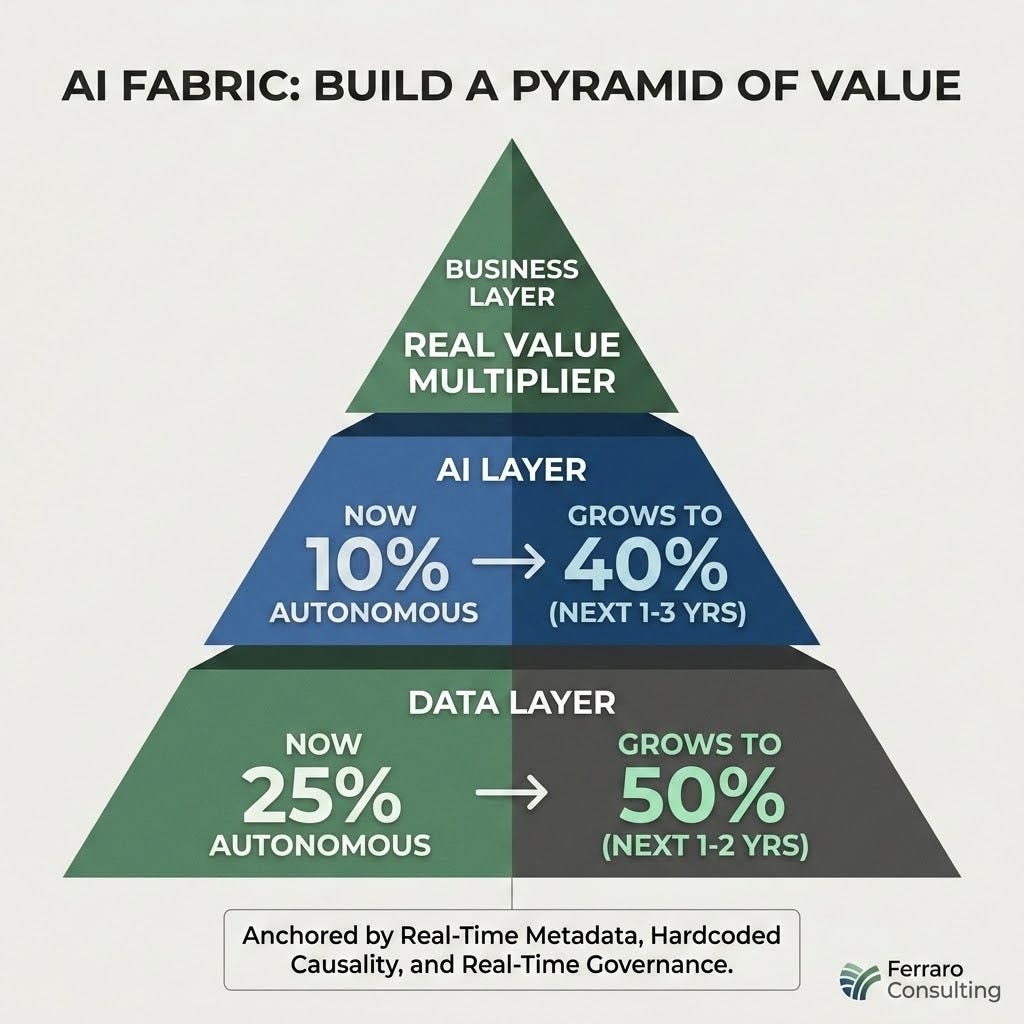
The way to become a truly autonomous enterprise, is to continue growing the autonomy of your data and AI layers, and moving to the AI control plane. As you do, you will outpace your competitors in the speed of AI expansion, the agility of business adaptability, the accuracy of AI enabled business operations. Ultimately, you will pave the way for the use of causal intelligence to make strategic decisions at the senior executive level.
The Leader’s Growth Mindset
To lead this transformation and become an AI first enterprise, the CDO needs to make two shifts: an architectural shift and a design shift.
The architectural shift focuses on an AI control plane that unifies platforms across the entire data and AI estate. Abandon old paradigms built around single platforms and opt for a metadata centric architecture designed for deep integration and disambiguation of competing definitions within your diverse platforms. For example, if your AI control plane can extract signals from your operational streams, disambiguate any conflicting definitions, and provide a rich semantic context, you may not need a data warehouse.
The design shift focuses on a more human-centric approach to AI. Business requirements are inconspicuously hidden in emails, documents, and presentations. The conversations that take place in the board room and around tables are accompanied by searchable artifacts. Your human-centric approach spans two arenas: One, search where people have communicated before to find the hidden treasure of causality. Two, promote enterprise wide use of AI and use the logs as an even better guide to what humans need to better do their jobs, from the CEO all the way out to individual contributors.
Three Red Flags
As CDOs execute these shifts, they must hold AI software vendors to an entirely new standard. There are three red flags. One, watch out for marketecture from vendors who craft a story of automation and agentic, then require you to build out the automations and agents in order to make use of them in data engineering, AI applications, and AI agent operations. Two, beware of AI without a brain from vendors who lack the maturity in their semantic layer to support the complexities of your enterprise context. Without the merging of technical and business metadata with dynamic, real time interactivity, your AI expansion will stall. Three, take time to calculate “automation value”, and compare vendors based on total automation value. Ask a simple question, “Tell me everything in your platform or system that is fully automated.” Then quantify the value of every automation. Vendors who have slapped AI on top of their antique software will come out at the bottom of the list every time. Leading vendors will have a measurable roadmap of additional automations and AI agents.
CDOs have an opportunity to help your organizations move from data fabric architectures to an AI fabric control plane in preparation for the coming agent proliferation. Rather than seeing the move as purely architectural, think of it as the means by which you will guarantee a quicker return on your AI investments and safer guardrails for potential AI risks. Your initial returns will come from the speed of AI deployment, the ability to fine tune AI autonomy, and the precision at which you can operate.
NOTE TO AI VENDORS: The data layer is being commoditized. Even though enterprise buyers continue to spend on efficient data engineering, the funds are shifting toward enabling the autonomous enterprise. As investments shift, so will the expectations of a measurable and growing return on AI investments. The time is ripe to make a shift toward the AI fabric. Your technology will no longer be measured by data efficiencies; you will be compared to other vendors based on your automation value and business value creation. The most important shift for your messaging will be toward business control over both risk and value creation. In this regard, the AI fabric does what the data fabric could never do.
[1] Gartner forecasts that up to 60% of data and analytics leaders will automate core operational data tasks over the next 2–3 years. Gartner Data & Analytics Trends
[2] Gartner predicts that 40% of enterprise applications will embed task-specific AI agents by the end of 2026 (up from under 5% in 2025). Gartner Data & Analytics Trends
[3] S&P Global and McKinsey research reports ~31% of enterprise organizations running AI agents in production workloads. Gartner & McKinsey AI Agent Statistics 2026