


The Reality Check: Enterprise AI is failing its first major operational stress test. Not because the technology is too smart, but because the solutions designed to “govern” it are inadequate.
The AI governance market has devolved into an expensive exercise in corporate and startup theater. Organizations are spending millions on software that promises protection but requires massive development or slow human intervention to make it operational. It is time to call out the rebranded data governance platforms, the partially operational startups, and the static frameworks for what they actually are: insufficient attempts to govern AI in a fast-changing, real time, non-deterministic world.
The Three Scandals of the Incumbent Market
1. The Rebranded Data Governance Hustle
Yesterday they tracked SQL tables and GDPR compliance; today, they slapped an “AI” sticker on the box and now claim they can manage autonomous multi-agent systems. Tracking data inputs and outputs is data governance. AI governance is the management of emergent behavior, probabilistic risk, model drift, and execution intent. You can’t fix an algorithmic intent shift by auditing data.
2. The Paperwork Factory
Nations and well-meaning associations are pumping out new AI governance frameworks as fast as ChatGPT can produce new content. Legacy GRC platforms have built automated workflow systems to generate compliance documentation, model cards, and system cards. They function like cloud-based spreadsheets, relying on human-filled intake and update. They flag incidents and measure risk, but they were not built for the operational requirements of AI governance. Paperwork and process recommendations will never provide the evidence necessary to operationalize data governance.
3. The Peripheral Illusion
The current market relies on API proxies, AI gateways, webhooks, or boundary-level constraints. These perimeter fences are designed for deterministic software. In an ecosystem of interconnected, self-improving agents, a superficial gateway is either easily bypassed or introduces latency that kills business execution. These legacy approaches to governing software will show well in a chatbot demo, but they are inadequate when it comes to governing the intent of an army of AI agents working together on behalf of a complex business ecosystem.
The New Paradigm: Algorithmic Business Assurance (ABA)
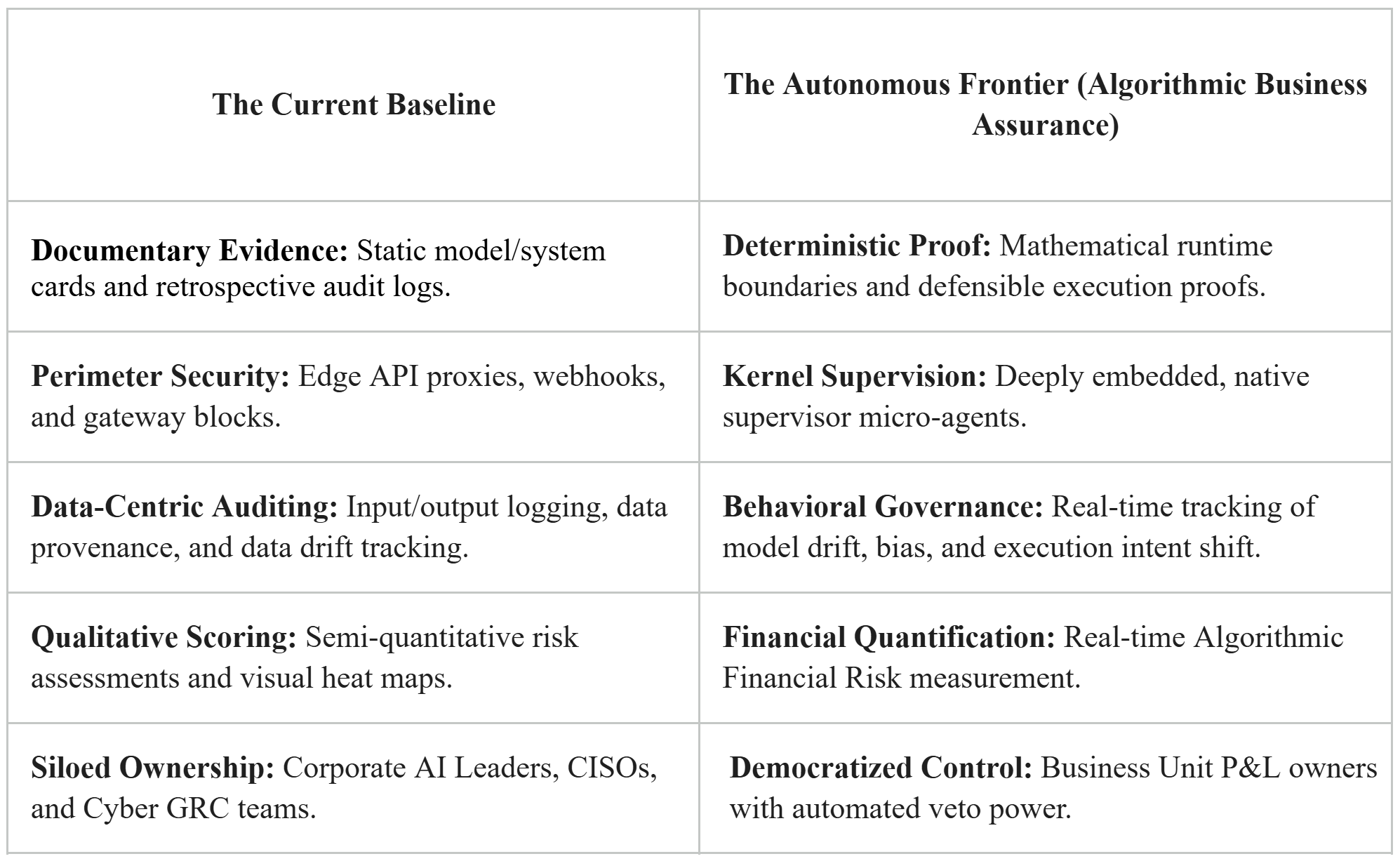
Because AI agents act on behalf of people and organizations, we reject the notion that AI governance belongs to an isolated compliance committee or an IT security silo. True AI governance must be a real-time business discipline. We are drawing a line in the sand between the old guard of passive tracking and the new frontier of active, mathematical assurance.
The Five Declarations of Absolute Assurance
I. From Retrospective Paperwork to Deterministic Execution Proofs
We must stop treating model cards and compliance reports as actual safety. They are static artifacts, outdated the moment they are compiled. True assurance requires deterministic runtime testing of probabilistic actions. Tests must be automatically generated at runtime and dynamic throughout their life. They must be written to generate real evidence, not just estimates of risk. If a model or an autonomous agent cannot mathematically prove it operated within explicit behavioral and regulatory boundaries during a transaction, the execution is dynamically invalidated before it can cause any harm.
II. Out of the Gateway, Into the Kernel
Perimeter guardrails are a relic of old software design. To govern highly autonomous multi-agent environments, the governance plane must sit natively inside the execution engine. We advocate for kernel-level supervisor micro-agents that continuously monitor internal tool calls, enforce dynamic least-privilege constraints, and audit the multi-agent trust chains from the inside out, without influence from the agent itself.
III. Govern the Intent, Not Just the Infrastructure
Monitoring data drift is no longer enough. AI systems change in production not just because the inputs change, but because their internal reasoning path diverges. True AI governance must actively isolate model drift, algorithmic bias, and execution intent shift. We must govern what the system is trying to accomplish, not just the pipeline it travels through.
IV. Real-Time Financial Risk Intervention
A qualitative risk score or a visual heatmap means nothing to a CEO during an incident. If risk cannot speak the language of liquidity, it is useless. Every single API call or agentic decision loop must be assigned an instantaneous economic liability score using dynamic exposure modeling:
Algorithmic Financial Risk = Likelihood of AI Intent Shift (%) × Negative Value Score × Total Dollar Value at Stake
When an autonomous agent attempts to execute a contract, process an insurance claim, or trade an asset where the real-time financial liability triggers a threshold breach, the system dynamically restricts or reroutes that action in stride.
V. Absolute Business Ownership
If an AI governance console requires a computer science PhD or a data science background to interpret, it can’t function in real time. The ultimate owner of the control plane must be the business unit leader carrying the P&L. Policies, guardrails, and risk tolerances must be managed in pure, natural business intent language, giving non-technical executives immediate, absolute decision power over the algorithms and the incidents. Without business ownership, agents cannot have true accountability.
The Ultimatum to the Enterprise
The era of treating AI governance as a defensive corporate box-ticking exercise is over. You cannot manage non-deterministic, fast-evolving AI systems with tools designed for static databases and point-in-time regulatory reporting.
The choice before enterprise executives is stark:
Continue deploying “governance bots” that document failures after they happen.
OR
Move to Algorithmic Business Assurance and architect systems that are mathematically incapable of violating your business intent.
Stop auditing your AI after it fails. Govern its execution in real time.