


Artificial intelligence has spent the last several years captivating us on digital screens, recommending what to watch, drafting emails, answering queries, and generating images. But a massive shift is underway: intelligence is spilling out into the physical world, where machines must sense, reason, and act while obeying the unforgiving laws of physics.
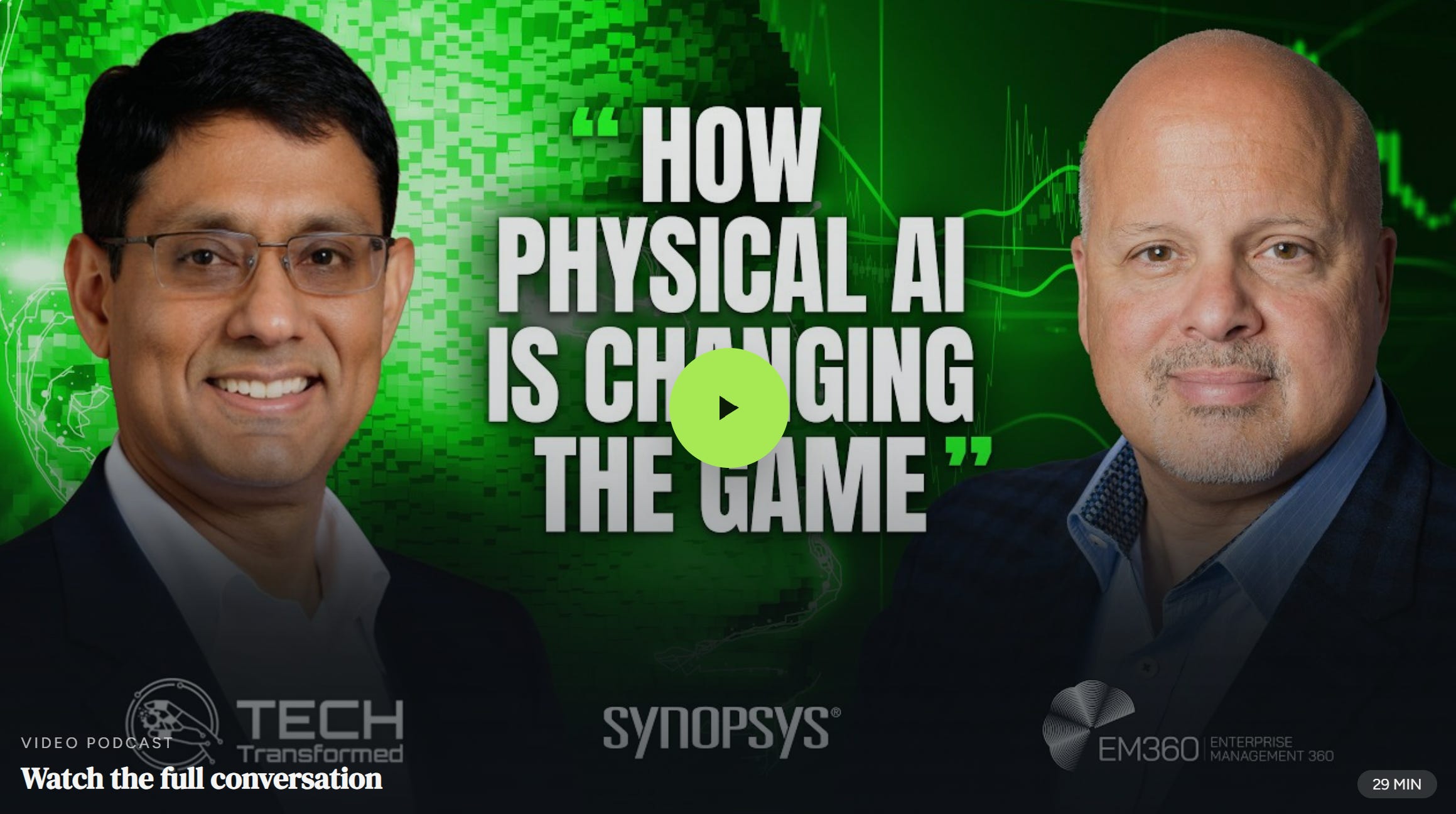
In a recent episode of Tech Transformed, sponsored by EM360Tech, host I got to sit down with Prith Banerjee, Senior Vice President of Innovation at Synopsys, to unpack what happens when AI transitions from the data center to the real world.
The Four Phases of the AI Revolution
AI didn’t just appear overnight; it evolved through distinct eras. During the episode, Prith laid out the clear progression that brought us to where we are today:
1. Analytics AI: The initial phase was focused on correlation and predictive algorithms, like Netflix recommendations or optimizing cell placement in chip design.
2. Generative AI: The breakthrough moment came when foundational models like ChatGPT become capable of generating text, images, and videos.
3. Agentic AI: The current wave unleashes autonomous AI agents to assist humans in complex workflows, working 24/7 across engineering, marketing, and legal tasks.
4. Physical AI: Machines (drones, autonomous vehicles, humanoid robots) now interact dynamically with their physical environment using local AI.
“The world around us is governed by the laws of physics... Can AI learn the physics around us? That’s the world of physical AI.”
— Prith Banerjee
How Physical AI Learns: Observation Over Assembly Code
To understand the revolutionary nature of Physical AI, just look at how robotics used to work.
A decade ago, teaching a robotic arm to pick up a simple bottle required writing nearly 100,000 lines of C or assembly code to manually control every motor, joint, and sensor.
Today, Physical AI flips that script. Much like a child learning to ride a bicycle by trial, error, and watching their parents, modern robots learn by observing human motion and leveraging synthetic data. Through physics-based simulations, Synopsys is enabling robots to train across thousands of virtual hours before ever stepping into a physical factory floor.
“Silicon to Systems”: Creating Super Engineers
Prith talked about how systems are getting smarter and chip complexity is exploding. We’ve moved from chips with 10,000 transistors to modern AI chips housing trillions of transistors (such as Cerebras’s 2.7-trillion transistor chip).
Designing these massive multi-die, 3D systems creates immense thermal, structural, and electrical challenges. As Prith noted, companies can’t simply hire 10 million engineers to keep up with the pace of innovation.
That’s where Synopsys’s Agentic Engineering comes in:
AI agents work alongside human engineers 24/7 on tasks like RTL design, test benches, and sign-offs.
Instead of replacing engineers, agentic workflows create “super engineers” capable of managing projects 100x more complex.
Multi-physics co-design optimizes Power, Performance, and Area (PPA) simultaneously, eliminating costly overdesign.
The Edge Challenge: Low Power, Safety, and Governance
Moving AI into autonomous physical systems presents new hurdles that digital software never had to deal with:
Latency & Low Power: A self-driving car can’t wait for a round-trip cloud query to decide when to brake. Inferencing must happen on the edge, requiring ultra-low-power chip designs (running on hundreds of watts instead of megawatts).
Collaborative Safety (Cobots): Robots working alongside humans must be designed so they never cause physical harm.
Traceability & Governance: If an autonomous system makes a physical decision, organizations must be able to trace why it made that choice; and they must be able to stop errant actions from ever taking place.
A Final Note on Our Guest
Prith Banerjee brings an incredible, rare vantage point to this conversation. From running HP Labs worldwide and serving as group CTO at industrial giants like ABB and Schneider Electric, to leading CTO efforts at ANSYS prior to its acquisition by Synopsys, his career spans every layer of hardware, software, and physical simulation.
For me, this interview was an honor. I remember my early days at HP. Prith was leading HP Labs and he was a legend. I got to shake his hand once but this is the first time I got to sit down with him and talk tech.
Whether you are a CIO, CTO, or tech enthusiast, the rise of Physical AI is going to reshape every industry from automotive to healthcare. My take: When Prith Banerjee talks, people should listen. Watch the full episode How Physical AI Is Rewiring Machines.
Special thanks to EM360Tech for sponsoring this episode of Tech Transformed. To explore more about the future of physical AI and chip design, visit Synopsys or connect with Prith Banerjee on LinkedIn.